
Peace out.
Catholic Reflector Chronicle/Vol. 6, Issue 6/June 15, 2026

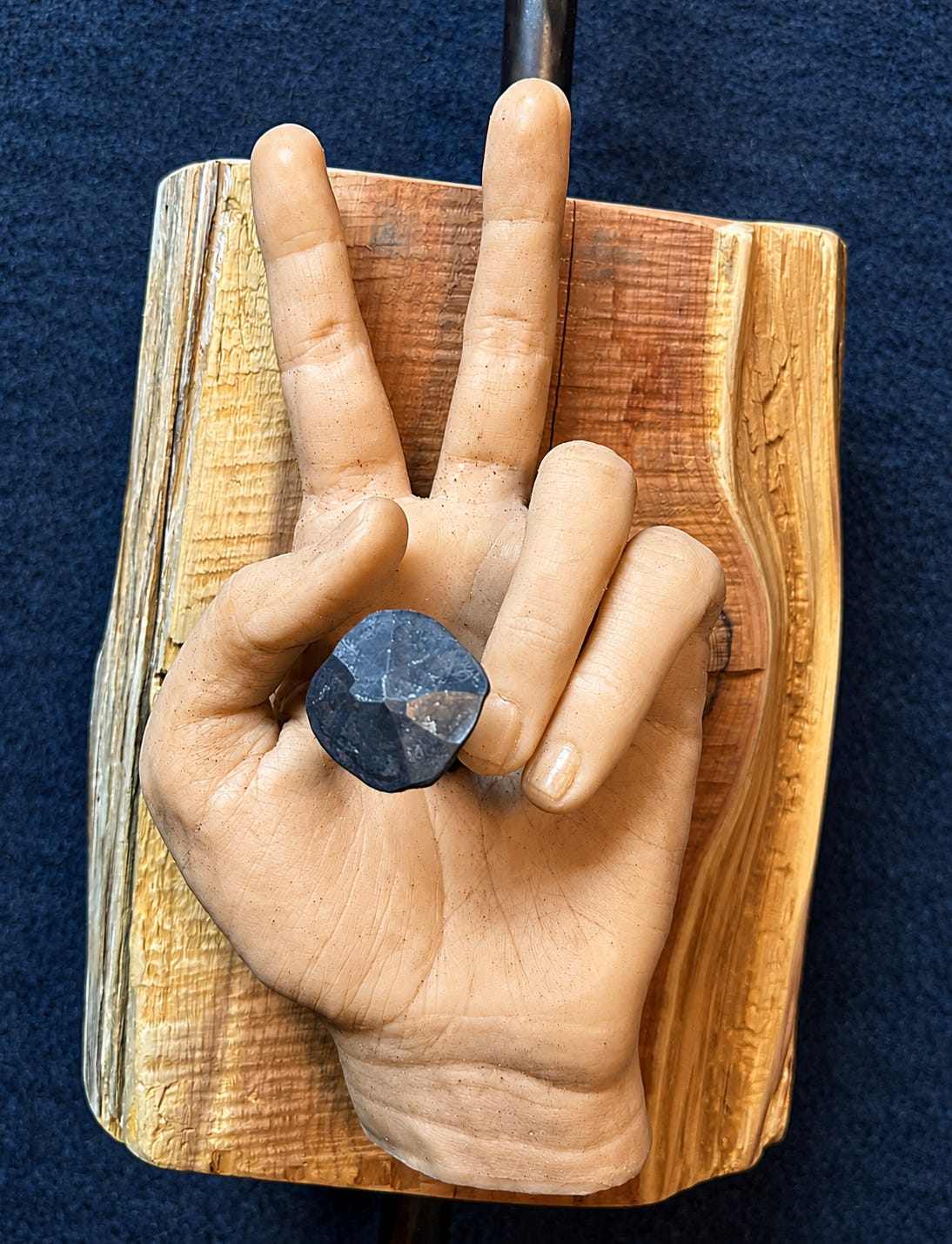
I love peace. Peace is great. Why, just the other day, someone commented to me, “Hey D.M., you’re such a peaceful guy!” “You’re almost as peaceful as you are humble.” But peaceful as I am, even I have my limits, and one of them is that most awkward of moments in the Novus Ordo Mass that comes just before Communion. The “sign” of peace.
After the Eucharistic Prayer, after the consecration, after we’ve spent the better part of an hour ascending Calvary with Our Lord, the priest invites everyone to exchange a sign of peace. People are turning this way and that, hands are reaching out, people wave across the pews, fist bumps, hugs, pandemonium… I’ve even seen conversations break out. Then, just as suddenly, we’re supposed to recollect ourselves and prepare to receive the Body, Blood, Soul, and Divinity of Jesus Christ. Receiving Christ is literally the most important thing you will do that day, or any day. C’mon!
I’d like to think that most Catholics have felt that this might not be appropriate, even if they’ve never quite put it into words. Again, I like peace. But the problem isn’t peace. The problem is placement.
The Sign of Peace is an ancient Christian practice, but it wasn’t originally conceived as a sort of liturgical meet-and-greet. In the Roman tradition, peace flowed from the altar. It was a sacred sign connected to the Eucharistic sacrifice itself, not primarily an expression of friendliness among the congregation.
This becomes especially clear in the Traditional Latin Mass. There, the faithful do not exchange handshakes or greetings before Communion. At a Solemn Mass, the kiss of peace may be exchanged among the sacred ministers, passing from the celebrant to the deacon and then to the subdeacon. The gesture remains closely connected to the altar and the sacrifice being offered. Meanwhile, the congregation remains recollected and focused on the approaching reception of Holy Communion.
Whether one prefers the Traditional liturgy or not, it’s hard to miss the logic. The closer we come to Communion, the more the liturgy narrows our attention toward Christ. It’s the reason why we are there.
By contrast, the modern exchange of peace often pulls our attention away from Christ at precisely the moment the liturgy is drawing us closer to Him. It’s breaking our concentration and focuses the Mass on us rather than on Christ. Sorry visitors, well-wishers, or distant relations, I don’t want any more of it. This placement is disordered.
Pope Benedict XVI recognized the difficulty. In Sacramentum Caritatis, he noted concerns that the exchange of peace can become distracting and suggested that its placement deserved further reflection. Unfortunately, he did not call for its abolition, but he acknowledged what many Catholics have observed firsthand. This gesture intended to foster peace interrupts the Mass.
Let’s consider some Scripture.
When Our Lord says, “If you are offering your gift at the altar and there remember that your brother has something against you, leave your gift there before the altar and go; first be reconciled to your brother” (Mt. 5:23-24), reconciliation happens before the offering of sacrifice, not immediately before receiving Communion.
While I prefer abolition, if the Church wishes to retain a communal sign of reconciliation, one could argue that a more fitting place would be before the Offertory. The symbolism would be straightforward and proper. We reconcile with one another before joining our sacrifices to Christ’s sacrifice. This reconciliation is what is meant by the sign of peace, it’s not just a greeting.
The Roman Rite had it right for centuries (right rite, right?) The deepest sign of unity among Christians is not a handshake. It is not a hug, and it’s certainly not a wave. It is Holy Communion itself.
St. Paul teaches, “Because there is one bread, we who are many are one body” (1 Cor. 10:17). Our unity flows from the Eucharist. We become one because we receive the One Lord. Not because of a communal handshake.
This why Traditional Catholics instinctively recoil when the Sign of Peace becomes a moment for waving, chatting, or flashing the hipster two-fingered "peace sign." (oh, how I hate the two-fingered peace sign). The liturgy is not asking us to exchange good vibes or friendly greetings. The peace being offered is not our own; it is Christ's. It is the peace won on Calvary, made present on the altar, and received in Holy Communion. The more the gesture resembles ordinary social interaction, the easier it becomes to forget the sacred reality it is meant to signify. At this point in the Mass, our attention should be fixed not on one another, but on the One who is about to give Himself to us.
Again, none of this is an argument against peace. Quite the opposite. Christian peace is too important to be reduced to a brief social exchange. True peace comes from reconciliation with God through the sacrifice of Christ. It descends from the altar before it extends to our neighbor.
This is what feels so off about the current placement. At the very moment when the Church is directing our attention toward the Lamb of God, we momentarily turn away from Him and toward one another.
Now, I certainly don’t expect the Curia to call me and tell me they read my Substack, and now they are moving the sign of peace. So, since this “practice’ will continue, a few tips:
Keep it simple.
A brief handshake, nod, or quiet “Peace be with you” is sufficient. The sign is meant to be a liturgical gesture, not a social event. No high fives, ever.
Stay focused on Christ.
The Sign of Peace is not an intermission. Keep your attention oriented toward the altar and the approaching reception of Holy Communion.
Exchange peace only with those nearby.
There’s no need to cross aisles, wave across the church, or seek out friends and family. The purpose is not to greet everyone in attendance. I have seen people literally go up and down the aisle giving handshakes and high fives. It made me wish I was on the end of the aisle so I could stick my foot out. Sorry, it’s true. I’m not always peaceful.
Avoid turning it into a conversation.
This is not the time for introductions, catching up, or discussing lunch plans. A simple gesture communicates the Church’s intention more clearly than words.
Let the peace of Christ be visible in your demeanor.
The most meaningful sign of peace may be your reverence, charity, and recollection. A warm smile and a prayerful spirit say much more than an elaborate gesture.
In sum, if the Sign of Peace helps us prepare for Communion with our Lord, it serves its purpose. If it distracts us from Communion with our Lord, perhaps it’s time to say, quite literally, “Peace out.”
God Bless.
Scripture to read and consider:
Matthew 5:23-24: 23 So when you are offering your gift at the altar, if you remember that your brother or sister has something against you, 24 leave your gift there before the altar and go; first be reconciled to your brother or sister,[b] and then come and offer your gift.
John 14:27: 27 Peace I leave with you; my peace I give to you. I do not give to you as the world gives. Do not let your hearts be troubled, and do not let them be afraid.
1 Corinthians 10:16–17: 16 The cup of blessing that we bless, is it not a sharing in the blood of Christ? The bread that we break, is it not a sharing in the body of Christ? 17 Because there is one bread, we who are many are one body, for we all partake of the one bread.
John 1:29: 29 The next day he saw Jesus coming toward him and declared, “Here is the Lamb of God who takes away the sin of the world!
Issue Quote(s):
St. Cyril of Jerusalem, c. 348-350 AD, Mystagogical Catechesis V, §3
“Then the deacon cries aloud, ‘Receive one another, and let us kiss one another.’ Think not that this kiss is of the same character as those given in public by common friends. It is not such. This kiss blends souls one with another and seeks complete forgiveness for them.”
St. Augustine, c. 411 AD, Sermon 272
“If therefore you wish to understand the Body of Christ, listen to the Apostle saying to the faithful: ‘Now you are the Body of Christ and individually members of it’ (1 Cor. 12:27). If therefore you are the Body of Christ and His members, it is your mystery that is placed on the Lord’s table; it is your mystery that you receive.
Upcoming Topic: The Invisible Protector you forget every day.
Disclaimer from the Editor: I have done just about everything wrong that a Catholic can do. I was born a Catholic, and by the Grace of God, managed to remain one. I hope these writings educate and edify you. I will make mistakes, and I am likely to offend a few folks along the way. That is not my intention. If you wish to discuss anything written or expressed in this newsletter, please reach out to the email address below. Questions, comments and rude remarks are welcome, one and all. And remember, if you are a practicing Catholic, practice harder!
® 2026 www.howtobecatholic.com Email: dm@howtobecatholic.com
According to the rubrics it’s optional. I decided long ago to opt out.
One of the good things our Bishop has done was to do away with the "sign of the peace." His reasoning was like yours in that we should be focused on the Eucharist. Now when I'm visiting a Mass that still does it I keep my focus on the altar, but if someone near me insists I just nod.