
Is Jesus Catholic?
Catholic Reflector Chronicle/Vol. 7, Issue 3/July 27, 2026

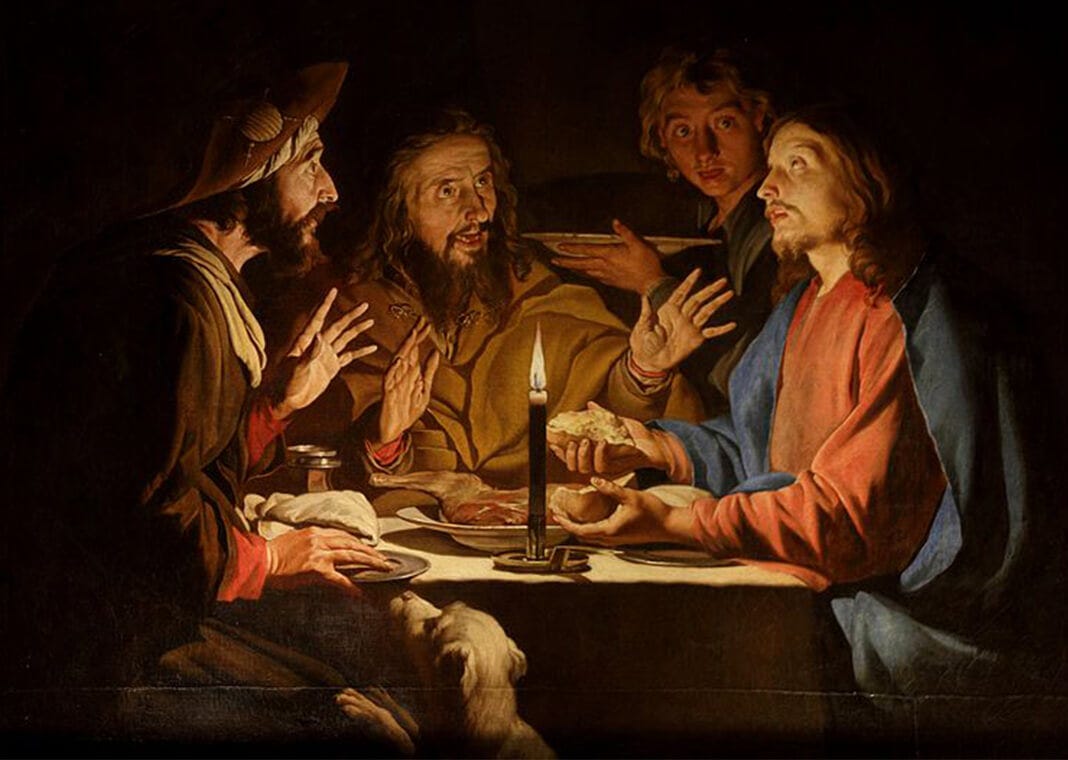
The Supper at Emmaus 1633-1639” by Matthias Stomer.
Ok folks, before you roll your eyes at the title, hear me out.
I’m not asking whether Jesus walked around first-century Judea calling Himself a Catholic. Of course He didn’t. And I’m not claiming He belonged to a denomination. Catholics don’t believe He did, because Catholics don’t believe the Church He founded was a denomination in the first place. Catholics do not believe Christianity began as one denomination among many. We believe Christ founded one visible Church, and that later divisions occurred from that original Church.
Most people picture Christianity as a tree with lots of equal branches, such as Catholic, Baptist, Lutheran, Methodist, Presbyterian, non-denominational, and so on. However, Catholics believe that Christ founded one Church, and that every Christian community that exists today ultimately traces its history back to that Church. In other words, Catholicism doesn’t claim to be one branch among many. It claims to be the trunk (with Jesus as the root of course).
Oh C’mon D.M, you’re just going to read Catholicism back into the Bible. I’ve heard this old song and dance before!
Maybe, maybe not. But remember, the Church existed before the New Testament was complete, and it was within that Church that the books of the New Testament were written, recognized, and handed on. We don’t come to the Bible with an empty head. Like it or not, every Christian reads Scripture through some tradition, the only difference being which tradition we trust. But which tradition most faithfully preserves the Church Christ established? Or in other words, does the Church Christ established look more Catholic than anything else?
To answer, let’s look at two things. First, what Jesus taught, and second, what the Christians who learned directly from His Apostles actually believed and did. Those two things should tell us a great deal about the Church Christ intended to build.
Jesus did was not write a book. He never said, “Here’s new Scripture. Now go read it, pray about it, and start churches as you see fit.” Nope, there wasn’t even a New Testament yet. When Christ refers to the Scriptures, He means the Books of the Old Testament. What Christ did do was establish a Church. “I will build My Church” (Matthew 16:18). Then He gave that Church authority. “He who hears you hears Me” (Luke 10:16). “Whatever you bind on earth shall be bound in heaven” (Matthew 16:19; 18:18). That’s not the establishment of an invisible association of independent believers, it’s the language of a kingdom. That’s a visible Church with authority. That’s the Catholic understanding of Christianity.
And regardless of what you think about the Papacy, Peter was important. Jesus didn’t simply congratulate him for knowing He was the Christ. He changed Simon’s name to Peter, the Rock. He gave him the keys of the Kingdom, echoing back to the royal steward described in Isaiah 22:20–22, in which the holder of the keys exercised the king’s authority in his absence. He told Peter to strengthen his brethren (Luke 22:32) and, after the Resurrection, to feed His sheep (John 21:15–17). Peter certainly wasn’t chosen because he was perfect, and that’s actually the point. The office of steward depended on Christ’s authority, not Peter’s (or any other man’s) perfection. This wasn’t some Catholic invention, it was biblical authority as Christ Himself would have understood it.
Now consider the Last Supper (I prefer First Supper, but I digress). If Jesus intended the heart of Christian worship to be simply preaching and studying Scripture, this would have been the time to say so. Instead, He took bread and wine and declared, “This is My Body... This is My Blood.” Then He commanded the Apostles, “Do this in remembrance of Me.” Early Christians understood this as more than a symbolic meal. Catholics believe Christ instituted the Eucharist and a ministerial priesthood to continue this sacramental worship until He comes again.
John chapter 6 drives this teaching home. Jesus tells the crowd they must eat His flesh and drink His blood if they would have life within them. Many disciples understood Him literally, and they were so troubled that they left Him. No one signed up for cannibalism, after all. If they had simply misunderstood a metaphor, this would have been the perfect opportunity to call them back and explain Himself. “Guys, wait, come, back! “I meant like my flesh and blood, I’m not crazy!” Nope. Instead, He lets them walk away and even asks the Twelve whether they will leave as well. Catholics take Him at His word. If Jesus believed what Catholics believe about the Eucharist, then perhaps Catholics aren't the ones adding something to Christianity.
Moving on, look at confessing and forgiveness of sins. Throughout the Gospels, Jesus forgives sins, prompting His critics to ask, correctly I might add, who but God can forgive sins. Then, after His Resurrection, He breathes on the Apostles and says, “Whose sins you forgive are forgiven them, and whose sins you retain are retained” (John 20:23). That’s an astonishing grant of authority. Catholics don’t confess their sins to priests because priests replace Christ. They confess because Christ chose to exercise His ministry of reconciliation through the men He commissioned. For more insight, read I can just confess my sins to God, right?
What about Mary? Well, there’s something about Mary. Catholics are accused of giving her too much attention. But look at Jesus, her son. He perfectly fulfilled the Fourth Commandment by honoring His mother. At Cana, He performed His first public miracle at her request, even thought his time had not yet come, and her only recorded instruction to the servants remains one of the best summaries of the Christian life: “Do whatever He tells you.” These are not meaningless details. At the Cross, He entrusted His mother to the beloved disciple (John 19:26–27). Catholics honor Mary because Jesus honored Mary. Authentic Marian devotion has never ended with her. It always leads to her Son.
Well, what about those pesky traditions? Did Jesus condemn all tradition? He condemned human traditions that nullified God’s commandments (Mark 7:8–13). That’s very different from rejecting the faithful handing on of divine teaching. Before a single book of the New Testament was written, the Gospel was being preached, the sacraments were already being administered, and the Apostles were handing on what Christ had entrusted to them. Christianity didn’t begin with a complete book, it began with Christ establishing a Church. This is why Catholics answer the title of this article the way they do.
So what did that Church actually look like?
We don’t have to guess, the early Christians wrote it down. Read the Didache, or Ignatius of Antioch, or Justin Martyr. The writings of Irenaeus are mind-blowing. These aren’t medieval Catholics responding to Luther, some of them are Christians living and writing while the Apostles' and their disciples were still alive. Believers didn’t gather for an informal Bible study in living rooms where everyone simply shared opinions about Scripture. They assembled every Sunday under the leadership of the bishop or one of his presbyters. Scripture was proclaimed, a homily was preached, the faithful offered common prayers, the Kiss of Peace was exchanged, bread and wine were brought forward, and the Eucharist stood at the center of everything. Even though they met in homes, they set apart a table that served as an altar, and by the early second century St. Ignatius of Antioch was speaking of each local church having “one altar” under “one bishop.” That sounds pretty Catholic.
It wasn’t fancy at first, but it was unmistakably sacred. Worship was not modeled after contemporary entertainment, its focus was prayer, sacrifice, Scripture, and the Eucharist.. The setting was simple, deeply reverent, and centered on entering the presence of God through the Eucharistic sacrifice. When the faithful strayed from this form, they were chastised. As Christianity emerged from persecution, house churches eventually became basilicas and cathedrals. But the essential pattern of Christian worship remained remarkably unchanged.
Remember folks, Jesus never separates faith from obedience. He calls people to believe, certainly, but He also calls them to repent, take up their cross, forgive, fast, pray, love their enemies, persevere, and keep His commandments. “If you love Me, you will keep My commandments” (John 14:15). That’s not salvation by earning God’s favor, it’s the ordinary life of discipleship. Catholics have always understood that genuine faith is living, active, and transformative because that’s how Jesus describes it.
The more I read the Gospels, and then compare them with the worship of the earliest Christians, the harder it becomes for me to imagine Jesus founding the kind of Christianity we often see today, where thousands of separate communities disagree about baptism, the Eucharist, church authority, ordination, marriage, divorce, and even fundamental moral teachings, all while while each claims to rely on the same Bible. The first generations of Christians certainly had disputes, but when serious disagreements arose, they appealed to apostolic authority, bishops, and the faith they had received, not to the idea that contradictory doctrines could all be equally correct.
They left us evidence of a liturgy whose basic shape is still recognizable in the Catholic Mass today. Jesus prayed that His followers would be one (John 17:20–23). He established a Church with shepherds, authority, sacramental worship, and a mission to teach all nations. That doesn’t sound like the level of doctrinal division we see today. It sounds remarkably like the Catholic Church’s own understanding of herself.
So, is Jesus Catholic?
Not if you mean He belonged to a denomination. He is the eternal Son of God, the Head of the Church, not a member of one branch of Christianity. But if by “Catholic” you mean believing what He taught, worshipping as He instructed, receiving the sacraments He instituted, recognizing the authority He gave His Apostles, and remaining united to the Church He founded, then I say “yes.”
So if Jesus walked into your church this Sunday, would he recognize it? If not, I’d simply encourage you to do two things. Open the Gospels with fresh eyes, and then read what the Christians who sat at the feet of the Apostles believed.
More on this from my post last year: The Catholic Mass is the Bible
The distance between Jesus and Catholicism isn’t nearly as great as you’ve been led to believe.
God bless.
Scripture to read and consider:
Ephesians 2:19-22: 19 So then you are no longer strangers and aliens, but you are citizens with the saints and also members of the household of God, 20 built upon the foundation of the apostles and prophets, with Christ Jesus himself as the cornerstone. 21 In him the whole structure is joined together and grows into a holy temple in the Lord; 22 in whom you also are built together spiritually into a dwelling place for God.
Ephesians 4:1-6: 4 I therefore, the prisoner in the Lord, beg you to lead a life worthy of the calling to which you have been called, 2 with all humility and gentleness, with patience, bearing with one another in love, 3 making every effort to maintain the unity of the Spirit in the bond of peace. 4 There is one body and one Spirit, just as you were called to the one hope of your calling, 5 one Lord, one faith, one baptism, 6 one God and Father of all, who is above all and through all and in all.
1 Timothy 3:15: 15 if I am delayed, you may know how one ought to behave in the household of God, which is the church of the living God, the pillar and bulwark of the truth.
Acts 2:42: 42 They devoted themselves to the apostles’ teaching and fellowship, to the breaking of bread and the prayers.
Issue Quote(s):
St. Ignatius of Antioch, c. A.D. 107, Letter to the Smyrnaeans 8:2:
“Wherever the bishop appears, there let the multitude be; even as wherever Jesus Christ is, there is the Catholic Church.”
St. Irenaeus of Lyons, c. A.D. 180, Against Heresies, Book III, Chapter 3, §§1–2:
“For it is a matter of necessity that every Church should agree with this Church [the Church at Rome], on account of its more excellent origin...”
Upcoming Topic: The Death Penalty as an Occasion for Salvation
Disclaimer from the Editor: I have done just about everything wrong that a Catholic can do. I was born a Catholic, and by the Grace of God, managed to remain one. I hope these writings educate and edify you. I will make mistakes, and I am likely to offend a few folks along the way. That is not my intention. If you wish to discuss anything written or expressed in this newsletter, please reach out to the email address below. Questions, comments and rude remarks are welcome, one and all. And remember, if you are a practicing Catholic, practice harder!
® 2026 www.howtobecatholic.com Email: dm@howtobecatholic.com
That was a beautiful explanation of the Faith! Thanks for sharing your insight with us all. Peace, Earl J.
Thank you ….Blessings from Australia.